U.S. Department of War weapons system platforms – from aircraft and maritime vessels to ground vehicles – are the foundation of military superiority. While kinetic threats remain constant, the rise of cyber and electronic warfare has placed these hardware platforms as high-value digital targets. These platforms depend on complex software networks, often using the MIL-STD-1553 serial bus protocol as the communication backbone between different subsystems that support communications, navigation, logistics, and more. As a result, compromising the MIL-STD-1553 bus can lead to grave consequences, including loss of life, platform destruction, and mission failure.
Shift5 has built the MIL-STD 1553 Detection Suite to equip military platforms to rapidly detect and respond to sophisticated serial bus attacks, increasing cyber survivability in the era of modern warfare.
MIL-STD-1553 Detection Suite
MIL-STD-1553 serial bus protocol serves as the ‘nervous system’ for a variety of software and hardware components onboard DoW weapons system platforms. Shift5 has launched the MIL-STD-1553 Detection Suite to analyze, detect, and alert for adversary attacks against this serial bus protocol to prevent the compromise and silent disruption of critical platform operations. Shift5 developed a variety of advanced techniques for detection to quickly identify suspicious activity operating outside of baseline or expected behavior.
The MIL-STD-1553 Detection Suite helps platform operators guard against several attacks, including:
- Malware Corruption of LRUs: When an attacker attempts to use previously planted malware on a subsystem to send malicious commands, receive unauthorized data, or gain access to command-and-control (C2) functions. A successful attack can result in an attacker gaining full control of a critical onboard computer.
- Denial-of-Service (DoS) Attacks: When an attacker attempts to flood the system with high volume or malformed message traffic. A successful attack can result in platform operators experiencing a communications blackout and/or loss of complete control and responsiveness of the platform.
How We Do This
- We connect our Manifold 4 data collection device directly on-platform to continuously ingest all raw serial bus data generated during live missions.
- Our Shift5 software deployed on the Manifold 4 device automatically translates and normalizes this data into a common format to enable advanced, on-platform data analytics.
- The MIL-STD-1553 Detection Suite continuously analyzes incoming MIL-STD-1553 data to flag anomalous bus activity that indicates malicious interference occurring on the platform.
- The platform operator receives an alert via an Electronic Flight Bag (EFB), such as Foreflight. Simultaneously, an alert is sent to the ground station and viewed in Shift5’s native desktop user interface (UI) or third-party application.
Scenario Example
A U.S. Department of War fixed-wing aircraft is flying over an Area of Responsibility (AOR) with a history of cyber attack. A remote attacker gains access to the aircraft’s system by infiltrating the software supply chain of the platform and attempts to send unauthorized commands to a flight computer line replaceable unit (LRU) to send unauthorized flight commands, placing the pilot’s safety and mission at risk.
Shift5’s MIL-STD-1553 Detection Suite immediately flags the command as suspicious. Shift5’s software sends an instant alert to the pilot and the ground station for situational awareness.
This cyber event is communicated by the ground station to other pilots operating in the same AOR to warn against potential cyber attack.
Defense in Depth: Multi-Layered Threat Detection
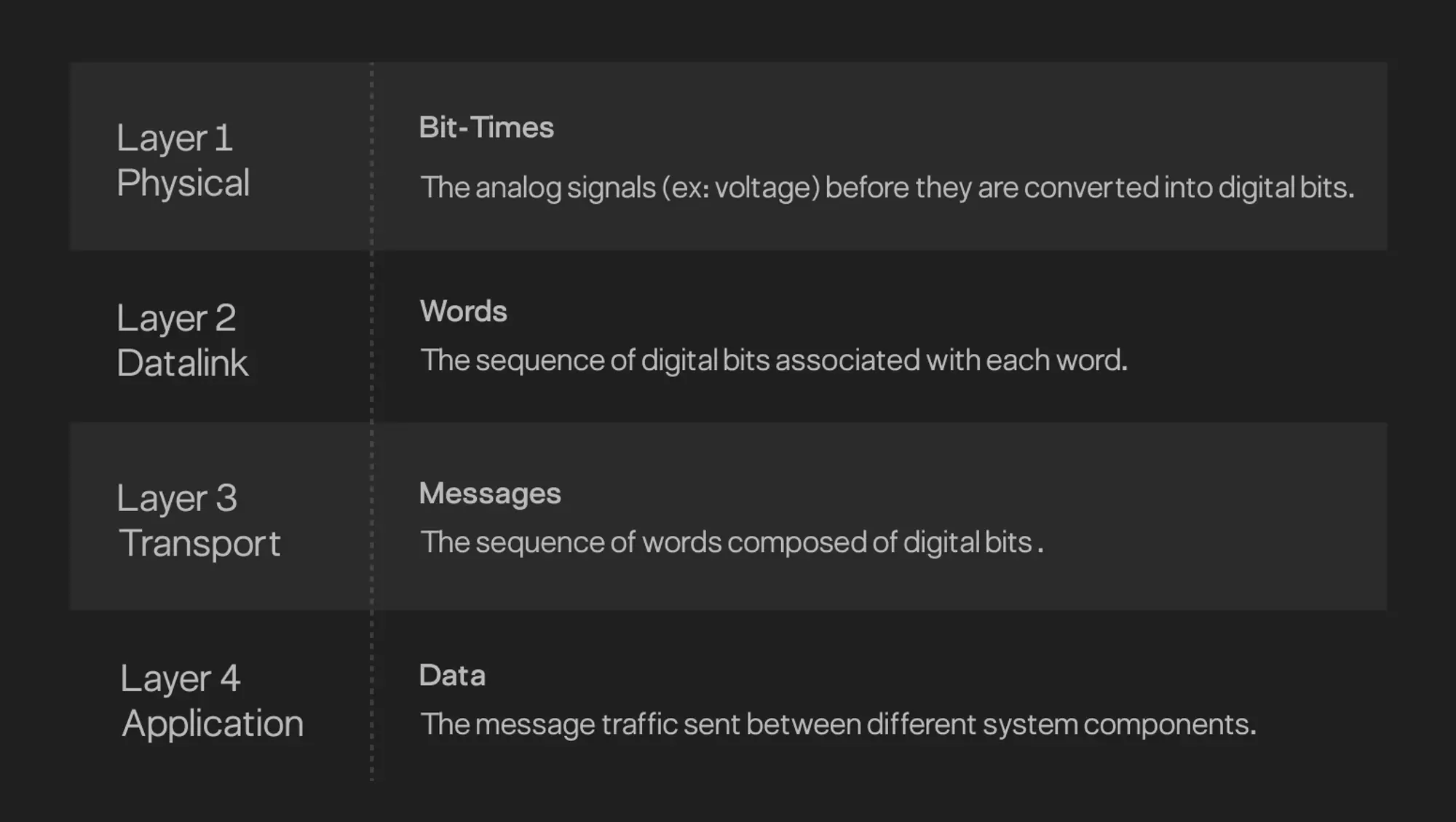
Serial bus protocols, including MIL-STD-1553, can generally be broken down into four distinct layers – from high-level application data to physical electrical signals that carry that application data – representing the breadth of impact that adversaries can target for access, manipulation, and more.
The 4-layer approach is based on the Open Systems Interconnection (OSI) reference model.
However, current cyber monitoring capabilities typically focus on detecting malicious activity only within protocol messages themselves (Transport Layer), leaving a significant blind spot in additional attack surfaces that adversaries can target for system intrusion.
We built the MIL-STD-1553 Detection Suite to achieve a true defense-in-depth security solution to identify subversive attempts at MIL-STD-1553 compromise across all digital and physical layers for comprehensive threat detection.
Safeguarding Your Mission with the MIL STD 1553 Detection Suite
The MIL-STD-1553 Detection Suite is now available for all U.S. military platforms operating the MIL-STD-1553 serial bus protocol. With the detection suite, platform operators and defensive cyber operations teams can:
- Gain comprehensive threat detection with full coverage analysis of all MIL-STD-1553 bus data.
- Discover cyber attacks in near-real time, on platform, at the edge.
- Receive immediate alerts to initiate safety protocols and other defensive action.
- Download and access data for post-mission forensic analysis to determine entry points, depth of intrusion, and more.
- View alerts and cybersecurity insights in Shift5’s native UI or existing third-party applications (e.g., Splunk, Elastic, Palantir Foundry).
The Shift5 Platform evolves continually – delivering new detections, analytics models, and mission-relevant capabilities for added operational value over time.
Ready to equip your mission with the latest cyber capabilities? Get in touch with our team today to learn more.
Interested in contributing to national defense? View our job openings at shift5.io/careers.